Russian Startup Livemap Lands $300K Grant For Its Motorcycle Helmet With Built-In Navigation


As we’re coming up on the next Consumer Electronics Show, I got an update from one of the companies that participated in TechCrunch’s Hardware Battlefield at the last CES — Russian startup Livemap.


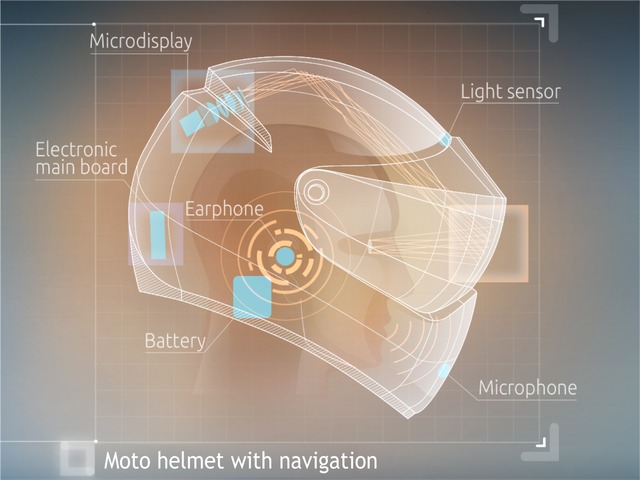
The Livemap team is working to create motorcycle helmets with voice control and GPS navigation directly in your field of vision — so while you’re riding, you can see directions in your helmet display without having to fiddle with another device or look away from the road. (Back in January, the Livemap team demonstrated an early version of their display, which was transparent enough to show a map without obscuring the road ahead.)


CEO Andrew Artishchev told me via email that most of the past year has been spent building the pre-production prototype of Livemap’s optics. Those optics will be built entirely of aspheric lenses, allowing the helmet to, in his words, be “smaller and lighter and sometimes cheaper than the multi-lens design.” He added that the other big focus has been creating a design that will keep the optics costs down.


Now Livemap plans to unveil its prototype in the spring, and to start sales this summer in its first market, the United States.


To help create the prototype, Livemap has also received a grant of 14.7 million rubles from the Russian Ministry of Science. (That’s a little under $300,000 in U.S. dollars.). If you’re fluent in Russian or don’t mind using Google Translate, you can read more about the grant here.


Artishchev also commented on the emergence of a new competitor, Skully, which he dismissed as “only part of Google Glass.”


“The product called Skully P1 is, in short words, like Google Glass put into a helmet — with all its disadvantages like tiny screen, low saturation and contrast, low resolution,” he added.


Featured Image: Livemap


from TechCrunch http://feedproxy.google.com/~r/Techcrunch/~3/ssGbWtwspYM/

via IFTTT

How Many Millions Should I Take From My Startup?


Dear Danny, I am a young founder currently finishing a fundraising process and have multiple term sheets at absurd valuations with no expectation of offering board seats. I am trying to find ways to distinguish between these offers, and I recently heard that some of my best friends are using VCs like ATMs, and taking millions off the table through secondary offerings. I only fly first class, but this secondary sounds premium. I was wondering if I can take millions off with my term sheet, and how many millions I should take? ~ Company Builder*


Company Builder, I congratulate you on developing your startup to the level where venture capitalists are willing to offer you obscene valuations with no hope of access to your board of directors. I understand getting to 100,000 users these days can be challenging, and I congratulate you on your tenacity to reach this special threshold.


As you heard from your friends, but far more likely from the media since it is unlikely you have many friends, venture capitalists are “fighting like drunken sailors” to get money into your startup, and that of your very own pocket. Through a device known as a secondary sale, you can put up some of your very own hard-earned equity in a fundraise process, and sell your shares at the round price.


Contrary to the beliefs of many (most notably anti-tech protestors in San Francisco), such secondary sales are actually in the best interests of the founder and the investor when done properly.


It’s all about incentives. When your startup is just starting out, your equity is worth less than the paper it is printed on. So there is very little threat of you giving up the business for an acquisition offer. Any offer is probably going to be too small to change your mind about building a company, and in fact, any offer will likely validate your beliefs that what you are doing is right (even though your cocky confidence probably doesn’t require any further validation).


But as your startup matures and finds success, turning down valuation offers becomes more and more difficult for even the most cocksure founder. It can be easy to ignore Google’s entreaties when they offer you $100,000 for your company (i.e. the starting salary for engineers at Google), but it is significantly more difficult to refuse when that number has another four zeros behind it.


That is where the conflict can brew between you and your investors. Your investors, particularly your later-stage investors, need you to push all the way to a massive exit in order to return any capital off of their previously ridiculous valuation. You, on the other hand, would probably be willing to accept a handsome payday of hundreds of millions of dollars.


To discourage you from selling early, venture capitalists will offer you secondary to align your interests together. By giving you some money up front, you don’t feel the same pressure to sell early to make a buck, and can instead concentrate on building a massive and sustainable business.


At its best, the secondary offered is commensurate with the remaining gains of a company. If you own, say, 25% of a company valued at a billion dollars, a couple of million or even $50 million in secondary is really not going to change the fact that a huge amount of money is still held up in paper equity. The kind of ambitious founders who can build such a valuable company rarely just quit when they get their first taste of cash.


Contrary to some of the analysis floating around, such secondary sales are hardly uncommon, and are in fact a typical consideration in later growth rounds where there is real concern that a young founder will be willing to charge through attractive acquisition offers in search of the big payday. In fact, unless a founder has had previously success in building a company (and getting wealthy from it), most later-stage VCs would be concerned if a founder never took secondary.


As you might have noticed, I have talked mostly about later-stage investors, while you, Company Builder, are running an early-stage company. Secondary in early-stage rounds is seemingly becoming more common for the most competitive deals, as we have seen with founders at Whisper and Secret. Here we have a bit more incentive conflict than we otherwise should.


If secondary is being offered earlier, there would certainly be an increasing incentive for a founder to quickly build notoriety and attention instead of a product, run around Sand Hill Road with open hands to receive term sheets, and quickly secure a multimillion dollar payday before anyone is the wiser. To my knowledge, such activities have so far been rare, but there is a serious risk for the ecosystem if millions are being offered before a product has even shown sustainability.


Ultimately, only you can decide what is right for your company and your own personal finances. Remember, this secondary isn’t free – it’s equity in your company that you are sacrificing for today dollars. If you are massively successful and grow the next Facebook, today dollars are going to look like a pittance compared to tomorrow dollars when your equity value has shot up. As long as you can pay the mortgage, I say, move forward.


*This email is fictional. I hope.


Featured Image: Lisa Brewster/Flickr UNDER A CC BY-SA 2.0 LICENSE


from TechCrunch http://feedproxy.google.com/~r/Techcrunch/~3/qean3Wxu8gM/

via IFTTT
On Immigration, Engineers Simply Don’t Trust VCs

After Alleged Rape In New Delhi, Uber Lays Out Additional Safety Measures In India


Following an incident in which one of its drivers allegedly raped a female passenger in New Delhi, ride-hailing company Uber has announced additional safety measures it is taking in India. Those precautions were announced ahead of a hearing that the local Transport Department will be having on Monday to determine whether Uber and other mobile transportation services should be allowed to operate there.


Last month, Uber came under scrutiny in New Delhi after a driver for the service was arrested and charged with rape. While the company said it was cooperating with local authorities following the incident, its service was quickly banned by the local government, along with other similar apps. As a result, Uber suspended its service there while reviewing its operations in the market.


Uber has long touted its trust and safety features, which typically include background and driver checks, as well as transparency into driver and passenger accounts and a two-sided rating system. But as others have pointed out, it’s not enough for Uber to rely simply on government records to ensure the driving and criminal records of its drivers are clean in some international markets. For instance, as Sriram Krishnan wrote after the incident in New Delhi, “Anyone who has spent any amount of time in India would know that background checks just don’t work and a certificate from the cops is just paperwork.”


In response, Uber has laid out additional measures it is taking to ensure passenger safety in the India market. That includes having all of its drivers reviewed again to ensure they have “authentic and valid police verification,” as well as hiring local “safety exerts” to detect fraud and to develop more effective screening methods for its drivers.


In addition to more advanced driver screening, Uber also says it is rolling out a local incident response team to resolve critical issues there. It is also adding a ShareMyETA button to the app, rolling it out first in India to allow passengers to send trip details to loved ones.


The measures were announced ahead of a hearing that the Delhi Transportation Department is holding on Monday to determine whether the service can resume in that market, according to the blog post.


Of course, Delhi is just one market where Uber is facing challenges from the local government. It recently come under fire in Portland, where it agreed to suspend service for three months while the legality of ride-sharing services are reviewed there. Regulators in Taiwan and Chinese city Chongqing are also reviewing the legality of its service, and in South Korea Uber CEO Travis Kalanick was indicted on charges of operating the service illegally in that market.


Meanwhile, the company has faced trust and safety concerns following a series of incidents in other markets. A driver for Uber in Boston was also charged with rape earlier this month. That incident follows the beating of an Uber passenger with a hammer in San Francisco, and an off-duty Uber driver being charged with vehicular manslaughter after striking and killing a 6-year old child last year.


Those incidents, combined with Uber’s fast rate of hiring — CEO Kalanick said the company was creating 50,000 jobs a month globally in September — have led some regulators to look more closely into the company’s screening and on-boarding processes. Earlier this month, the District Attorneys of San Francisco and Los Angeles filed suit against the company for claims it made about the quality of its background checks.


As a result, Uber has committed to investing more in customer safety around the world. But some of those investments — most prominently its ShareMyETA button — will roll out in India first.


from TechCrunch http://feedproxy.google.com/~r/Techcrunch/~3/zY_B-jLGA5E/

via IFTTT

When Will Your Phone Replace Your Keys And Wallet?


When I leave my home, I check that I have three things: keys, wallet, phone. How long will it be until the first two are obsolete? My wallet has only three things I actually need: credit cards, cash, ID. Any American with an iPhone 6 has already obsoleted credit cards, courtesy of Apple Pay. Any Kenyan, Senegalese, etc. with a phone has long obsoleted cash, courtesy of M-Pesa, Orange Money, etc.


As for ID, well, if you’re in Iowa, just wait: “Iowans will soon be able to use a mobile app on their smartphones as their official driver’s license … sometime in 2015.” Can the other 49 states be far behind? Well, yes. But will they be? I doubt it. Expect a profusion of government ID apps sometime over the next few years.


In America, cash is still the real sticking point for wallet replacement. Maybe, if we’re lucky, Coinbase, ChangeTip, and other Bitcoin startups will eventually drag America up to near-equivalence with African e-cash. I certainly wouldn’t expecting American banks and carriers to do it.


What about keys? Already set. KwikSet’s Kevo locks (I would link to their site, but there’s an incredibly annoying autoplaying video with audio on their home page, so forget it) let you use Bluetooth LE to open your home. Lockitron (which has a much nicer home page, go click on them instead) does much the same. Both also let you send temporary e-keys to guests, a very cool feature not available for physical locks.


So in principle, if you live in Iowa, and don’t much use cash, then as soon as next year, you can buy one of those electronic locks and get rid of your keys and wallet forever…


…but you probably won’t. Because if you ask me, the real obstacle barring key/wallet replacement isn’t apps; it’s redundancy. Lose your phone today, and you can still pay for a ride home and let yourself in. But if your phone doubles as your key and your wallet, then if/when it’s lost or stolen, you are suddenly screwed beyond belief.


Especially since most online services are moving to two-factor authorization, in which the second factor is … a code sent to your phone. Which in turn is much more vulnerable than your keys or wallet. You don’t spend half your waking time waving the latter two around.


So: I predict that within the next 2-3 years, many of you will be able to replace your keys and wallet with your phone — but few if you will actually do so, until and unless the redundancy problem is solved.


Various solutions do immediately occur, but all are imperfect. The ability to temporary download your phone’s authorizations/settings onto a new/borrowed phone? Maybe, but that sounds like a key-management security nightmare to me. (Private encryption key, not physical door-opening key.) Temporary authorization for a friend or trusted service who can take you home and open your door? Again, not without its own flaws.


Oh yes. And remember: unless you own a Blackphone, you don’t control your phone. Its manufacturer does, its carrier does, and whoever wrote its OS does, but you probably don’t have root on its main microprocessor, and you definitely don’t have root on its baseband processor or its SIM card. Do you really want your every financial transaction, your entire legal identity, and your access to your own home to be dictated by a device controlled not by you, but by multiple separate mega-conglomerates? With absolutely no fallback to dumb incorruptible brute-force real-world entities such as steel keys and $50 bills?


I too would like to leave my home with only my phone and leave my keys and wallet in the past where they belong. But it seems like before we do that en masse, we need to solve the same problems that seem to be erupting everywhere else around our world, both online and offline: redundancy, security, and trust.


from TechCrunch http://feedproxy.google.com/~r/Techcrunch/~3/jBrK6EGXjXg/

via IFTTT

Lizard Squad attacks Tor network, ignoring warning from Anonymous

Lizard Squad attacks Tor network, ignoring warning from AnonymousLizard Squad, the group believed to be behind the Christmas DDoS attacks on Xbox Live and PlayStation Network now has a new target -- Tor. Just a week ago, the leader of the Tor Project, Roger Dingledine, warned that the anonymizing network could come under attack, and now it seems as though his prediction was correct.


War has already been declared on Lizard Squad by Anonymous, but this does not seem to have been enough to deter the group from its attacks. Reports suggest that more than 3,000 Tor relays have been compromised, and there are fears that this could impact on the anonymity Tor was designed to offer.


Yesterday, Lizard Squad announced that it was no longer targeting Xbox Live and the PlayStation Network. It's not clear whether this decision came as a result of Kim Dotcom's intervention but by switching its attention to Tor, the group is certainly trying to draw attention to itself:


While there have been claims that Lizard Squad is incapable of taking on Tor, it seems that there have been successful attacks. Security researcher Nadim Kobeissi tweeted a screenshot that shows a large number of relays named LizardNSA:


The Tor Project released a statement which seems to suggest that things are under control:


This looks like a regular attempt at a Sybil attack: the attackers have signed up many new relays in hopes of becoming a large fraction of the network. But even though they are running thousands of new relays, their relays currently make up less than 1% of the Tor network by capacity. We are working now to remove these relays from the network before they become a threat, and we don't expect any anonymity or performance effects based on what we've seen so far.


There's something of a war of words underway at the moment as well. Despite the fact that many of the member of Lizard Squad, and the associated Finest Squad, have been doxed (had their personal details published online), the Lizard Squad Twitter feed remains defiant:


from BetaNews http://feeds.betanews.com/~r/bn/~3/8jjyzV9-Qm8/

via IFTTT

Thumb Typing Is Changing Our Brains


Smartphones are changing us, at least according to researchers at the Institute of Neuroinformatics of the University of Zurich. It seems that as we moved from phones with buttons – Blackberrys and even feature phones – the parts of our brain associated with the thumbs are changing thanks to increased screen typing activity.


In short, when we use smartphones our brains show more activity in the parts associated with the thumb – not a surprising thing – but this reaction only happened in users of touchscreen phones. From the release:


Ghosh was also able to demonstrate that the frequency of Smartphone usage influences cortical activity. The more the Smartphone had been used in the previous ten days, the greater the signal in the brain. This correlation was the strongest, i.e. proportional, in the area that represented the thumb.


The scientists studied “37 right-handed people, of whom 26 were touchscreen Smartphone users and 11 users of old cellphones.” They found that cortical brain activity in the area associated with thumb control was higher in the touchscreen users. This actually points to similar findings in violinists whose brains change as they get better at the instrument.


Does this mean you’ll get a super brain if you keep tapping away on your iPhone? Probably not, but it does sound like what we tap affects how we think.


from TechCrunch http://feedproxy.google.com/~r/Techcrunch/~3/UcjlP-pQTBc/

via IFTTT