Join New York’s Mayor de Blasio At TechCrunch Disrupt New York

The best thing about Disrupt is that it brings together so many amazing people. To wit: New York Mayor de Blasio will join us on state at Disrupt New York for an amazing interview with our own Kim-Mai Cutler.

Mayor Bill de Blasio succeeds a Disrupt favorite, former Mayor Mike Bloomberg, on our stage and will talk about the future of and in New York. A former New York City Public Advocate and ombudsman, the Mayor is used to mediating the world of everyday citizens and the political powers that be. He’s already working hard at changes to the city that aim to increase network connectivity for all five boroughs and Digital.NYC, a hub for startups in the city.

Join us on Monday at noon for this intimate and unique interview on our Disrupt NY stage.

The show starts on Monday, May 4 at 9 a.m. with a talk between Ron Conway of SV Angel and Fred Wilson of Union Square Ventures. The speaker lineup is amazing. From the FCC Chairman Tom Wheeler to a talk about bitcoins with the Winklevoss twins, this is one of the best rosters we’ve ever had. We’re honored to have de Blasio at the event.

General admission tickets are still available, but they’re going fast and furious. Grab one before the show starts on Monday.


from TechCrunch http://feedproxy.google.com/~r/Techcrunch/~3/b04SbXeOUKQ/
via IFTTT

Tinder Sees Huge Jump In App Revenue Rankings, Courtesy Of Tinder Plus

Dating app Tinder’s move into the subscription business seems to be paying off. According to remarks made by parent company IAC during its quarterly earnings reported this week, the company is pleased with Tinder’s penetration rates – it reached its current level of penetration quicker than IAC’s OkCupid did, in fact – and renewal rates are higher than any other product, the company said.

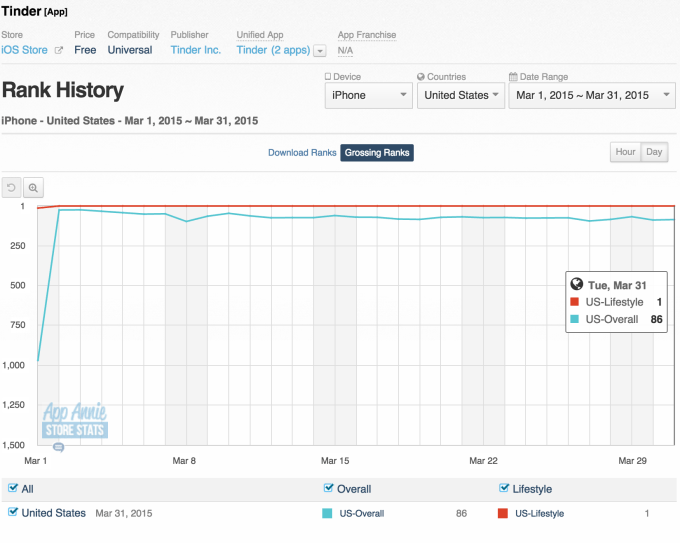
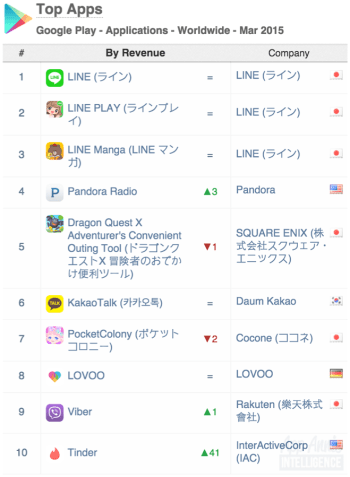
Now new data from app store analytics firm App Annie also showcases Tinder’s climb in the charts following the release of Tinder’s subscription service Tinder Plus, which saw the app moving up six spots in Google Play’s revenue rankings, while on iOS it jumped up from #969 in Overall revenue rankings to #26.

Tinder reached that #26 position on March 2nd – when the Tinder Plus subscription service debuted. So while the jump is related to a launch event, it’s still a massive leap over a short period of time. More importantly, perhaps, is that throughout the month of March the app remained in the top 100 Overall revenue rankings on iOS. It also climbed up from #14 in Lifestyle prior to the Tinder Plus launch to maintain a #1 position throughout the month.

The app is still riding high today, at #1 in Lifestyle and #43 Overall on iOS; and #1 in Lifestyle and #89 Overall on Google Play.

Screen Shot 2015-05-01 at 10.30.20 AM

05-Top-Apps-Google-Play-Apps-Worldwide-March-2015

In case you missed it, Tinder Plus was the dating app’s first move to generate subscription revenue for its previously free service. Instead of restricting core features like IAC does with other products out of its Match Group, including Match.com and OkCupid, for example, Tinder Plus adds to the app’s main feature set by offering in-demand options like the ability to undo errant swipes, for example, and Passport, a way search for matches beyond your current physical location. It also made a more risky move by limiting the number of right swipes. For unlimited swipes, you have to pay.

The company has been experimenting with its revenue model, charging a range of prices for access to the Tinder Plus subscription based on users’ ages, starting at $10 per month, as well as running in-app advertisements. Its ad with Bud Light “blew away our expectations in terms of user engagement,”  IAC chairman Greg Blatt said this week

IAC last year stated that Tinder could produce $75 million in revenue in 2015. Some analysts are coming in with different figures, however. Barclays analyst Chris Merwin, for example, pegged Tinder’s quarterly revenue at $10 million to $12 million.

But IAC is bullish on the subscription service. Tinder Plus’s “payment and renewal rates came in solidly against expectations,” Match Group chairman Greg Blatt said in a statement.

Revenue from IAC’s numerous dating sites grew 2% in the quarter, and the number of paid subscribers grew by 16%. Overall revenue in The Match Group grew by 13%. Many of those new subscribers are Tinder Plus users, IAC said, attributing some portion of the growth in dating paid members to the launch of this new subscription service.

Credit Suisse believes Tinder Plus has reached 100,000 subscribers while Morgan Stanley is estimating 297,000 paying users. However, the latter firm believes the company will have to double its subscriber base to meet revenue expectations.

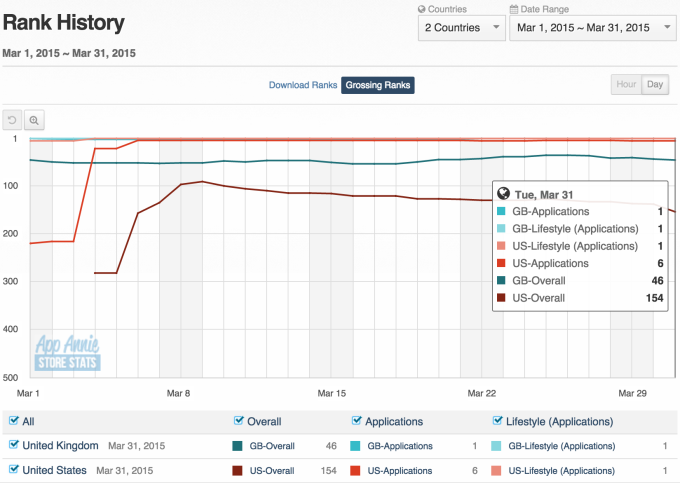
App Annie’s data hints at Tinder Plus’s growth, too – in addition to climbing the charts and jumping up in the revenue rankings, the subscription service also saw strong uptake in both the U.S. and U.K., the firm found. (Both those markets sport user bases that tend to pay for premium apps and services).

Screen Shot 2015-05-01 at 10.29.36 AM

Tinder’s parent company isn’t talking about Tinder’s monthly active users, specifically. But it did report that Q1 2015 was the highest registration quarter for the app that it has seen to date, and the growth in active users remains strong.

Tinder’s app has been estimated to have 22 million to 24 million users, as of late last year. IAC said in December the app had been downloaded over 40 million times, and users were swiping left or right more than a billion times per day.

Tinder Plus resonated with users because it gave them the option to pay for features they had wanted for some time, and the company is now poised to continue that model going forward, it seems. Blatt says the company has “10 other features” they’re going to layer on top of Tinder in the long-term.


from TechCrunch http://feedproxy.google.com/~r/Techcrunch/~3/tweXI9jis-w/
via IFTTT

11 Stories You Don’t Want To Miss This Week

TC-weekly-roundup

From Tesla’s Powerwall to Microsoft Build, here are the top stories from the past week of April 25-May 1.

1. Tesla’s Powerwall will let households run entirely on solar energy. The battery is rechargeable lithium-ion — it uses Tesla’s existing battery tech — and can be fixed to a wall, removing much of the existing complexity around using a local power source.

2. Microsoft announced the launch of Visual Studio Code, a lightweight cross-platform code editor for writing modern web and cloud applications that will run on OS X, Linux and Windows.

3. Kim-Mai Cutler examined the impact of Facebook’s new HQ on surrounding real estate prices. Facebook is in the best position to re-imagine what new urbanism looks like in the old heart of Silicon Valley.

4. Uber is planning to launch a same-day merchant delivery program.

5. Developers might not like it, but Facebook is strengthening privacy by removing its API for giving friends’ data to apps.

6. Darrell Etherington reviewed the Apple Watch. He explains that the Apple Watch is a design feat, no matter how you look at it.

applewatch-2

7. Anonymous sharing app Secret shuts down. Danny Crichton explains why Secret’s shutdown is an interesting case.

8. It was another big week for earnings. Apple had a killer quarter, but LinkedIn and Twitter shares both got crushed.

9. John Biggs checked out Cinder, a smart grill that cooks everything to perfection.

img_52441

10. Microsoft announced that it’s new browser will be called Edge.

11. What if wireless power at a distance actually worked? It does. uBeam invented a way to wirelessly send energy up to 15 feet away with ultrasound.


from TechCrunch http://feedproxy.google.com/~r/Techcrunch/~3/dUo6cXpj0pc/
via IFTTT

Rocana Lands $15M To Bring Big Data Analysis To IT Ops

Rocana (formerly ScalingData) announced $15M in Series B funding led by Google Ventures with General Catalyst Partners, Toba Capital and Paul Sagan (former chairman at Akamai and current executive in residence at General Catalyst) also contributing.

This round brings the total raised to $19.4M.

Rocana aims to simplify and speed up how companies running large data center operation teams track and fix issues across their systems. As companies move increasingly into mobile and cloud services, they are finding that it’s more difficult to track problems in these heterogeneous environments, Omer Trajman, Rocana co-Founder and CEO explained.

His company calls what they do “root cause analysis” because they can trace from the system all the way down to the root cause of the problem wherever it happens to be.

Companies used to have simpler systems that were easier to understand and control, but today they have to deal with a myriad of technologies such as OpenStack, Hadoop and Docker. While these tools solve some hard problems, they also add layers of complexity.

Donald Fischer, a venture partner at General Catalyst says one of the things that attracted his firm to Rocana was finding a way to attack this changing landscape with a new approach. “From my seat, I hear things are getting more complicated and more heterogeneous in terms of what’s being deployed in the data center,” he said.

What’s more he was hearing that the traditional tools, designed for a simpler data center weren’t keeping up. “When we looked at tools for managing IT ops, most of the tools are getting [long] in tooth. These are products from [IBM, HP] and BMC. These tools were built before Docker, OpenStack and Mesosphere. We’ve heard those tools are have a hard time keeping up,” he said.

That opened up an opportunity for a startup like Rocana. The founders looked at the changes in the data center and saw this as a big data problem because of the massive amounts of data coming in from disparate sources across these increasingly complex systems. They chose to use Hadoop and adjacent technologies like Apache Spark and Apache Solr to attack it.

The company appears to be a new twist on applications performance management from companies like New Relic or AppDyamics, but Trajman says they are more of complement to what Rocana is doing.

“New Relic is really helping people understand at the application level how it’s performing and whether something is going wrong, but when you actually dive into the infrastructure, it’s a very different view of the stack.”

He says the difference is New Relic lets you know something went wrong in a certain part of the application and Rocana will you give a detailed reason why it went wrong at the infrastructure level and how you can fix it.

A more analogous competitor might be DataDog, which also provides detailed infrastructure and software analysis to IT operations staff.

Regardless, there are few startups operating alone in any particular market segment. Rocana has 20 employees today in Boston and San Francisco. Trajman predicts that could increase two or three times in the next year armed with its fresh pocketful of millions.

Featured Image: Christian Newton/Flickr UNDER A CC BY 2.0 LICENSE

from TechCrunch http://feedproxy.google.com/~r/Techcrunch/~3/sFxVT-GWtGA/
via IFTTT

Over-The-Air HDTV Makes Xbox One A Near-Perfect Cord Cutting Console

Microsoft announced support for over-the-air TV broadcasts, including HD content, early in April. I’ve been using the setup since, after enrolling in the Xbox One Preview program and receiving a Mohu Leaf indoor HDTV antenna and an Hauppauge 955Q USB TV tuner to take it for a test ride. The end result is that for me, at least, Xbox One is closer than ever to achieving its vision of being the one device to rule them all when it comes to home entertainment.

That’s sort of the vision Microsoft laid out for Xbox One when it first unveiled the console; in fact, many criticized the company after the fact for focusing too much on the new Xbox’s general media capabilities, and not enough on games. But the reality of addressing the needs of a broad audience when it comes to media consumption means covering a wide range of possible content destinations, and getting there has been an uphill battle.

Recently, however, the Xbox One has acquired some new powers that mean it could basically be the only thing hooked up to my TV, and I’d be happy. Netflix is one key ingredient, and the most long-standing in terms of Xbox One’s capabilities, but the relatively recent addition of Plex was a powerful one, and now this over-the-air broadcast TV support pretty much seals the deal.

IMG_0376

I’ve been happily living without any kind of cable or satellite TV, or even broadcast, for years now. But the ability to add it quickly and cheaply to my Xbox One setup, without recurring fees, and with excellent picture quality and sound, as well as OneGuide integration and other neat features like live TV pause and voice control.

I was able to pick up all of the primary broadcast networks here in Canada (though none of the U.S. ones from across the lake in Buffalo, sadly), and one of the immediately apparent benefits was for live sports broadcasts, as I found out watching the hockey playoffs. Then I promptly remembered that I couldn’t care less about sports and shut that off, but it’s a nice feature if you’re into that sort of thing.

My wish list for Xbox One media capabilities is dwindling: HBO Now would be nice, once the exclusivity agreement with Apple expires, and I’d like to be able to mirror my phone but that would require the unnatural addition of AirPlay, which seems unlikely. Still, if you stripped my home theater setup down to just the Xbox One, from a media perspective, I’d now be more or less satisfied.

You still need to be part of the Xbox One Preview program to use this for the moment, but general availability is coming soon.

Note: The washout in the above images come from using a projector during the day in a room with a window. Not ideal but I barely use the TV while the sun’s out.


from TechCrunch http://feedproxy.google.com/~r/Techcrunch/~3/OYuwvgshY0c/
via IFTTT

Meerkat Launches Its Android App To All

Live video streaming app Meerkat beat Twitter’s own Periscope to market on iOS, and now it’s available on Android for all, with no Periscope app for Google’s mobile OS to be seen. The Meerkat app for Android carries a “Beta” label, as did a previous version that was locked down only to a select group of invitees, but it doesn’t appear to have that many limitations in terms of device options, and the core feature list is fairly complete relative to the iOS version.

Viewing streams from the app seems to work well, and the app retains the same rules as the iOS version, meaning that you can’t re-watch feeds once they’ve gone. The app’s decisions to push quickly on Android in order to get some breathing room between itself and Twitter-owned Periscope on that platform is probably a good strategy, but we’ll see if that ends up resulting in a significant or defensible first-mover advantage on the platform.

Expect hiccups since that beta tag is still in place, but if you’ve been craving some Android Twitter live streaming goodness, now’s your chance to get some.


from TechCrunch http://feedproxy.google.com/~r/Techcrunch/~3/gRLGI1_pYqk/
via IFTTT

After Exiting Marko Media, Mark Pearson Launches New London-Based VC Fund And Startup Studio

Aside from a bout of self-diagnosed “man flu” and being mildly irritated that the exit of one of his portfolio companies wouldn’t now close before the end of the tax year, Mark Pearson was in high spirits during our call a few weeks ago.

And perhaps he has every reason to be. After selling Markco Media, the parent company of MyVoucherCodes, last year, the U.K entrepreneur and ‘secret millionaire” is poised to make his next bet in the form of a new startup studio and early-stage VC fund.

“What excites me the most is I like to get quite hands-on and detailed and work with the companies I invest in,” he tells me. “The money’s one thing, but actually it’s the nurture and the mentorship, the helping you get over the hurdles. I always look at business and startups as ‘you’ve just got to win more battles than you lose’.”

The studio is important as I’ve always seen the real value that can be created by bringing together like minded entrepreneurs under one roof.
— Mark Pearson
Specifically, Fuel.Ventures, co-founded by Pearson alongside Paul Rous, an entrepreneur and ex-corporate financier who was previously at Goldman Sachs, is a new open-ended EIS early-stage investment fund targeting e-commerce startups. It plans to invest at the “super-early seed”, seed and A round stage.

However, it’s the corresponding Fuel.Studio, which aims to help create and incubate between 5 and 10 startups per year, that has Pearson most animated.

He says that the idea of doing a studio model — which, with unchecked hubris, he likens to creating a London-based Rocket Internet or Betaworks — was born out of his experience with Marko Media, where he previously housed five of his portfolio companies alongside the main business.

“The studio is important as I’ve always seen the real value that can be created by bringing together like minded entrepreneurs under one roof. This enabled what I see as key behaviours for success to be amplified between the individuals and companies within this studio set up, such as blue sky thinking, collaboration, problem solving and healthy competitiveness.

“There is immense value created by putting together leaders with expertise in their respective fields of technology, sales and marketing. This creates a key market leading advantage for the businesses housed and created within our studio setup.”

In addition, by creating a hub of companies, there are “resource and capital efficiencies” to be made, such as in the areas of HR, accounting and legal.

Personally I find the Silicon Roundabout area to be very overrated.
— Mark Pearson
The Fuel.Ventures fund and studio is based in London — where Pearson, who grew up in Liverpool, has lived for the last 17 years — although he is no fan of ‘Silicon Roundabout’, instead choosing to set up shop in the city’s West End.

“Personally I find the Silicon Roundabout area to be very overrated. As well as being home to some successful tech companies, it has also become a magnet for time wasters and wannabes, who are actually not willing to put in the time and effort to build real businesses.”

Meanwhile, although the decision to focus on e-commerce means that Pearson is staying within his comfort zone, he says the sector is “booming”.

“There has never been a better time in the history of the internet and e-commerce to be investing in and launching new companies, and in turn, creating substantial value in a rapidly growing commerce sector.

“With European e-commerce forecast to increase from $166.4 billion in 2014 to over $248 billion by 2017. Increased e-commerce user adoption, the proliferation on mobile handset and tablets, and the opportunities opened up by 4G have created huge potential for investors with the right investment approach.”

I am a good spotter of bullshit and am able to filter this out quickly to enable me to find the hidden gems
— Mark Pearson
And the “right investment approach” is something Pearson is confident he has, citing a portfolio that includes a number of fast-growing technology companies.

The most notable is Ve Interactive, an e-commerce “performance and conversion platform” that was recently valued at over £1.2 billion and in which Pearson invested £500,000 early on. Others include Paddle, Calq, Shopwave and Linkdex, while Playlists.net recently exited.

“I am a good spotter of bullshit and am able to filter this out quickly to enable me to find the hidden gems that will become the next big business,” says Pearson.

“I take pride that I have the experience of building highly successful companies of my own and taking them to exit, but best of all companies I have spotted and invested in early have eclipsed even my own successful track record. My investment portfolio is already worth more than double my own personal exits, with plenty more growth in the next few years. This is the reason why Fuel.Ventures fund and startup studio is my next major focus”.


from TechCrunch http://feedproxy.google.com/~r/Techcrunch/~3/Ff-9HC_cB88/
via IFTTT