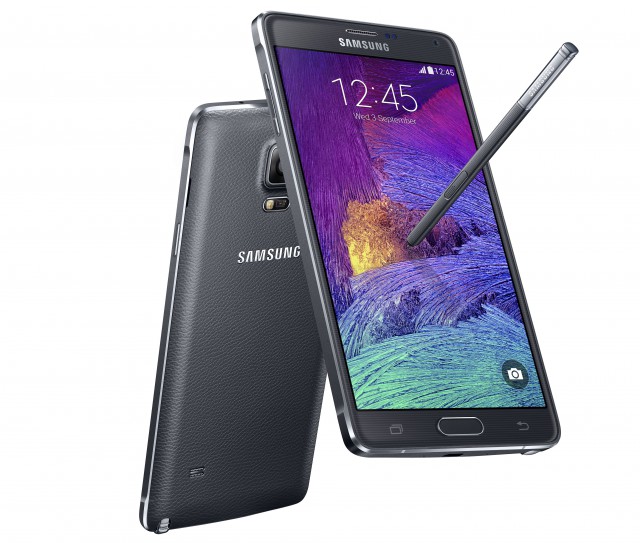
Samsung unveils a better Galaxy Note 4 -- faster download speeds in tow

Samsung Galaxy Note 4 N910 Black


Samsung has unveiled a new version of its Galaxy Note 4, featuring support for LTE Advanced Tri-Band Carrier Aggregation and Category 9 cellular networks. Dubbed Galaxy Note 4 LTE-A, it promises much faster download speeds over 4G LTE compared to the regular models, which the South Korean maker announced in early-September.


Galaxy Note 4 LTE-A is capable of offering download speeds of up to 450 Mbps. To put things into perspective, that is 50 percent faster than the Qualcomm Snapdragon 805-equipped Galaxy Note 4 -- which is no slouch to begin with -- and a whopping 200 percent faster than the Exynos-powered model.


However, Galaxy Note 4 LTE-A will only be able to reach those kind of download speeds later in 2015, when 4G LTE Category 9 cellular networks are expected to be commercially available. That being said, the phablet does have another trick up its sleeve, which it will be able to use much sooner.


Because it features LTE-A Tri-Band Carrier Aggregation, Galaxy Note 4 LTE-A can connect to three cellular network bands at the same time, and, as the name of the technology implies, aggregate them into one, juiced-up connection.


Compared to the Snapdragon 805-powered Galaxy Note 4 -- which can only connect to up to two bands simultaneously -- the new model is better equipped to maximize the transfer speeds offered by today's fastest 4G LTE cellular networks, which enable download speeds of up to 300 Mbps.


One thing that Samsung is not clear on is which processor powers the new Galaxy Note 4 LTE-A. Is it still Snapdragon 805, or has Qualcomm supplied its newer Snapdragon 810? Given Samsung's track record, I'm inclined to believe it is the latter.


There is no official word yet regarding where Galaxy Note 4 LTE-A will be available, and how much it will cost when it goes on sale.


from BetaNews http://feeds.betanews.com/~r/bn/~3/QWg91x_7HEM/

via IFTTT

Book wakeup calls from strangers with Wakie

Wakie


There are a vast number of alarm clock apps available for every platform, most of which are tired variations on the same thing: choose a skin, set a wakeup sound/ method, and that’s about it.


Wakie is an iOS and Android alarm clock app with a difference. Forget custom audio files or complicated snooze functions, instead you’re called by another Wakie user, who chats, sings songs, ask you questions, or otherwise gets your day off to a much more interesting start.


If this idea makes you a little uncomfortable, then you’re not alone, but the app does include some important safeguards.


The calls are routed through Wakie, so the caller never gets to see your phone number or find out who you are.


Calls are automatically cut off after 60 seconds, too. There’s no time for your chat to get awkward, and even if it did, you can just hang up.


The developer also says the app "learns" who you like to connect with, so presumably will try to match you with your preferred gender/ age range, most of the time.


Alternatively, if you don’t need to receive a call, you can volunteer to make one yourself. Just click “Wake Someone Up” and you’ll be sent push notifications whenever someone needs a call. (You’ll need an internet connection to wake someone up, although not to be woken, as you’ll receive a regular phone call.)


There are some restrictions and issues. In particular, Wakie only works in a few countries at the moment: the USA, Canada, the UK, Ireland, Hong Kong and Singapore. More English language countries are due to be added soon, with further expansion to follow.


As the system relies on other people calling you, your alarm time won’t be as precise as with automated apps. The official FAQ says they could be out by plus or minus five minutes.


But the good news is that, if there’s no-one around to make your call, Wakie does have an automated system which steps in, makes the connection and plays you a pre-recorded message.


There’s no telling quite what sort of call you’re going to get with Wakie, and that’s probably the point. If you want complete safety then stick to your phone’s built-in alarm app; but if you’re happy to gamble with a random caller -- who, even if they turn out to be an idiot, will still at least wake you up -- then this is certainly a more interesting and personal way to start your day.


from BetaNews http://feeds.betanews.com/~r/bn/~3/GIuTwcGGvtI/

via IFTTT

Xiaomi Confirms It Raised $1.1B At $45B Valuation


Xiaomi, the fast-growing Chinese hardware company best known for its low-cost smartphones, confirmed today that has raised $1.1 billion in new funding at a valuation of $45 billion. In a Facebook post, Xiaomi co-founder and president Bin Lin said the round was raised from investors including All-Stars Investment, DST, GIC, Hopu Fund, and Yunfeng Capital.


“This is an affirmation of Xiaomi’s stellar results in the four years, and heralds in a new phase for the company,” said Lin, adding that Xiaomi will unveil a new flagship device next month (reportedly a new smartphone that will make its first appearance at CES).


Xiaomi’s latest round was first reported by the Wall Street Journal last week. Its present valuation of $45 million is a significant increase over its previous valuation of $10 billion in August 2013, which Xiaomi director Hans Tung confirmed after its last funding announcement.


The company will likely use the capital to increase sales of its smartphones in its key growth markets of India, Southeast Asia, Brazil, and Mexico. In 2013, Xiaomi said it sold about 19 million phones, a number it hopes will more than double to 40 million units by the end of this year. In October, the company became the world’s third-largest smartphone vendor by shipment volume, according to both Strategy Analytics and IDC.


Featured Image: Xiaomi


from TechCrunch http://feedproxy.google.com/~r/Techcrunch/~3/Pt9bF5i90Sg/

via IFTTT

Gmail Now Even More Inaccessible In China


China has made it increasingly difficult to use Google services, including Gmail, this year. Now Gmail users are blocked from a workaround that allowed them to access their emails through third-party services.


Previously, people could still download messages through apps like Apple Mail and Microsoft Outlook, which use POP, SMAP, and IMAP. Now it appears that these servers have also have been blocked by China’s Great Firewall. This means users in China will only be able to access Gmail through a VPN service.


Google’s own Transparency Report shows a dramatic drop-off in traffic to Gmail from China that started on Friday. A Google spokesperson for Asia said “we’ve checked and there’s nothing wrong on our end.”


Gmail China


While Google has been subject to censorship since launching Google.cn in 2006, China has recently imposed even stricter limitations on its services. In June, before the 25th anniversary of the Tiananmen Square massacre, China blocked several Google sites, including Google+, Gchat, Gmail, Google Calendar, and Google Drive.


Featured Image: Shutterstock


from TechCrunch http://feedproxy.google.com/~r/Techcrunch/~3/5zyQ3Y6QmD4/

via IFTTT

Pinterest Will Open Promoted Pins To All Advertisers Following Success Of Beta Program


After years of questions about how it will make revenue, Pinterest roadmap to monetization is becoming more clear. The company announced today that its Promoted Pins, which it made available in beta to certain brands eight months ago, have performed “just as good and sometimes better than organic Pins” and it will make the program available to all advertisers on January 1.


Pinterest claims that brands who participated in the Promoted Pins beta program saw a 30 percent increase in “earned media”—or the amount of people who save a Promoted Pin to one of the boards. Promoted Pins are repinned an average of 11 times, the same as a normal pin made by one of the site’s users. Furthermore, Promoted Pins continued to get more pins in the month after a campaign, or a 5 percent increase in earned media.


Once the Promoted Pins program rolls out, Pinterest says advertisers will have access to more ad formats and advanced targeting. In addition, it’s also launched the Pinstitute, a twee name for a program that will show advertisers how to leverage Promoted Pins through workshops and webinars.


The Pinstitute follows the launch of Pinterest’s analytic dashboard in August, which lets advertisers track how their pins performed and how much content is being pinned from their sites through Pinterest’s Pin It buttons.


Pinterest has been focused on monetizing its site since raising an impressive $225 million Series E in October 2013, which valued the company at $3.8 billion. At that time, Pinterest said one of the key uses of the capital would be to continue development of monetization, which it first began testing around the same time it closed its Series E, into a global program.


from TechCrunch http://feedproxy.google.com/~r/Techcrunch/~3/oSmgGTzYQtQ/

via IFTTT

‘The Interview’ Nets $15 Million In Online Sales During Opening Four Days


Sony has revealed that The Interview has earned $15 million in consumer spending via rentals and purchases across online platforms in its first four days of online availability. A source with knowledge of the matter confirms that the overwhelming majority of these sales occurred through Google Play and YouTube Movies, meaning Google’s ability to rally and offer up its media stores as sales platforms helped considerably with Sony’s ability to get eyeballs on the gross-out buddy comedy that sparked international incidents and terrorism fears.


The Interview’s opening performance online has already helped it become the number one online film of all time for Sony Pictures Entertainment. Sony released the film beginning at 1 PM ET on Christmas Eve day, via Google Play, YouTube Movies, Microsoft’s Xbox Movies and SeeTheInterview.com. It has been streamed more than 2 million times already since being made available, according to Sony.


While The Interview was cited as the reason behind the massive hack that sent Sony Pictures essentially back to the stone age, thus far it doesn’t appear that there has been any retaliation from the original hacker group for its eventual release. Sony’s PlayStation Network, and Xbox Live, were both taken down over the past few days beginning on Christmas, but that seems an unrelated move, instead performed by hacker group Lizard Squad mainly “for the lulz,” per the group’s official social media presence.


from TechCrunch http://feedproxy.google.com/~r/Techcrunch/~3/K_VjRP-pu-A/

via IFTTT

Access to Gmail is blocked in China

Access to Gmail is blocked in China


China is one of the more 'interesting' counties when it comes to its attitude to allowing unfettered access to the internet. The Great Firewall of China is famed for the restrictions it places on the online activities of Chinese citizens. New data seems to suggest that Google's Gmail is currently blocked in the country.


Dyn Research, a web traffic research company, reports that Gmail traffic is being blocked at the IP level rendering Google's email service inaccessible within most of China. The disruption appears to have started late on Christmas day and is still on-going.


You can see the drop in traffic for yourself thanks to Google's Transparency Report. The interactive graph shows that there was a sharp drop in Gmail traffic as Christmas day drew to a close. There is a bit of fluctuation for a while, but then there is a prolonged period of flat-lining. There's no sign of things improving.


Speaking to Mashable, Dyn Research's vice-president of data analytics Earl Zmijewski said that "China has a number of ways they can block content. One of the crudest ways is to just block an IP address, and when you do that, you block all the content available at the IP".


A tweet from the company confirmed its findings of an IP level block on Gmail when the site is served from Hong Kong:


Hong Kong is significant as Zmijewski explains that a lot of Chinese Gmail traffic is routed through IP addresses in the region.


China has a history of censoring and blocking web access. News agencies and other online services find that they have a constant game of cat and mouse if they are to evade the firewall or censors. Google has not yet indicted whether it will take any steps to get Gmail up and running in China.


Photo credit: ArtisticPhoto / Shutterstock


from BetaNews http://feeds.betanews.com/~r/bn/~3/UMGZaHHVkoU/

via IFTTT